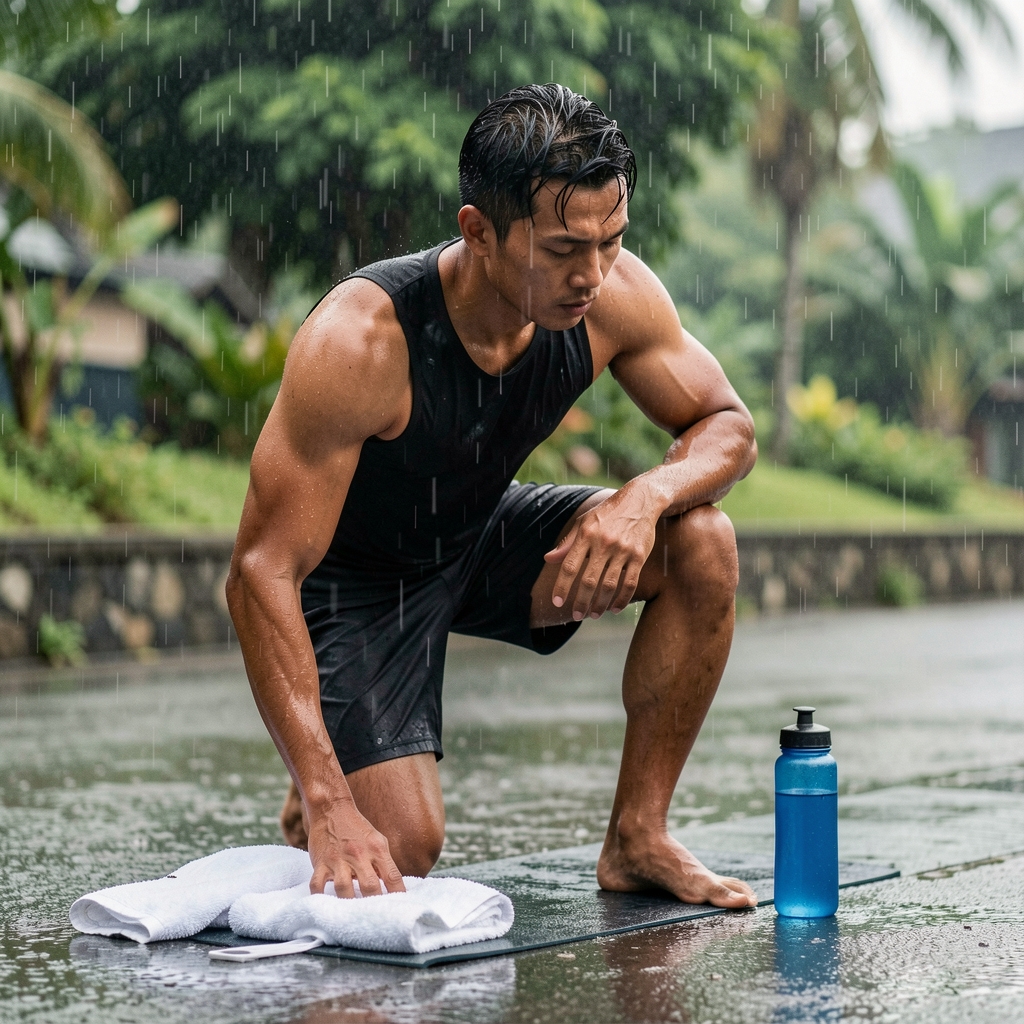
CLIMATE
Heat changes the cost of familiar work.
Humidity can reduce evaporation and make a steady pace feel unexpectedly demanding. Plan with fluids, shade, acclimation, and conservative interpretation.
In Jakarta, a familiar route can feel different from one morning to the next. Air movement, cloud cover, clothing, sleep, recent workload, and the time of day all influence the internal response to an identical distance. A pace number therefore needs context before it becomes a conclusion.
This guide is educational rather than personal health advice. It offers a framework for observation, planning, and communication with a qualified professional when a concern falls outside ordinary training questions.
Before a hot session
- Check the forecast and identify shade or an exit route.
- Start hydrated without treating water as a substitute for medical advice.
- Reduce intensity when the environment changes the internal response.
- Stop and seek help for confusion, faintness, chest symptoms, or severe weakness.
Preparation is less about predicting a perfect session than about creating choices. A route with water access, public shade, and a simple turn-back point reduces the pressure to continue when conditions change. Early starts may help with heat exposure, but they do not remove humidity or the need to monitor how the body feels.
Clothing should allow practical movement and reasonable airflow. A cap, towel, and charged phone can be useful logistical items. None of these objects replaces judgment; they simply make a conservative decision easier to carry out.
Heat is a load multiplier
Heat is a training variable. It deserves the same planning attention as distance, elevation, and surface.
The distinction between external work and internal response is especially useful here. The external work may be a familiar five-kilometre loop, while the internal response is elevated because cooling is less efficient. Recording both helps prevent a misleading comparison between a cool morning and a humid afternoon.
| Observation | What it may describe | Practical response |
|---|---|---|
| Pace falls while effort rises | Environmental cost or accumulated fatigue | Ease effort and shorten the planned session |
| Breathing feels unusually strained | Internal response is changing | Move to shade and reassess calmly |
| Concentration becomes difficult | A safety concern, not a performance target | Stop, seek company, and obtain help if needed |
| Recovery feels prolonged | Session and environment may have exceeded context | Prioritise rest and review the next day |
A conservative decision path
- Observe: note temperature, humidity, route, clothing, pace, effort, and how the session began.
- Compare: use similar conditions when comparing sessions, rather than treating every number as equivalent.
- Adjust: lower intensity, add breaks, select shade, or end the session when the response is not settling.
- Record: write a short note while the experience is fresh, including what helped and what did not.
Progress in a warm climate often comes from learning which variables can be controlled and which must simply be respected. A training plan can be precise without being rigid. It may contain a primary option, an easier option, and a clear reason to stop.
“A useful climate plan is not the one that protects a number; it is the one that protects the quality of the decision.”
— Solace editorial desk
When the environment changes, the plan changes
Confusion, faintness, chest symptoms, severe weakness, or rapidly worsening discomfort require an appropriate local response. Do not use an article to delay urgent assistance. For ordinary editorial questions, contact Solace at Jalan Cempaka Putih Raya No. 15, RT.8/RW.5, Cempaka Putih Barat, Kota Jakarta Pusat, Daerah Khusus Ibukota Jakarta 10520, Indonesia, or +62 21 726 1835.